12 October 2026
Pan, undying joy
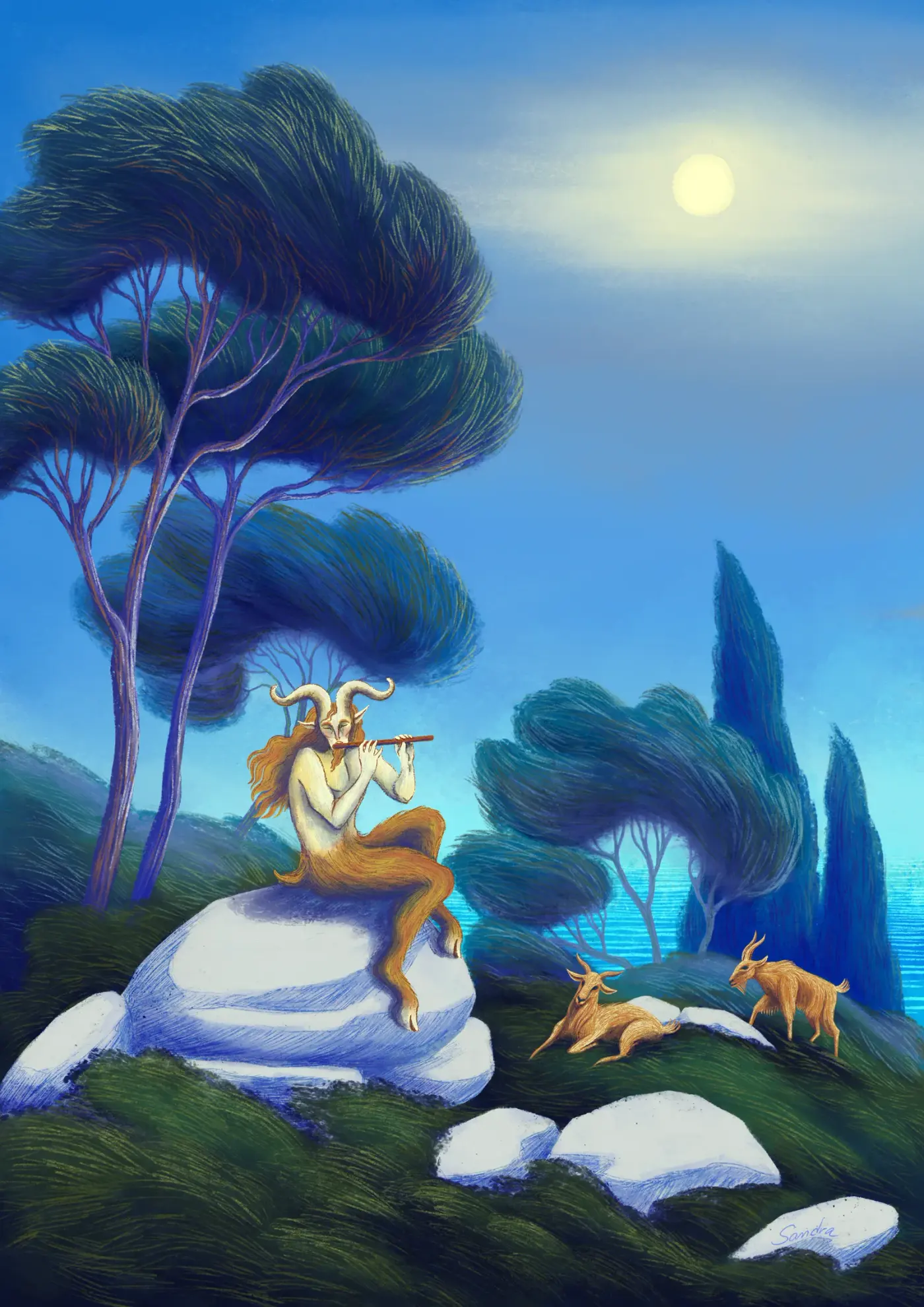
A flute's tune echoes against the cave walls. At first it's a muffled hiss, smothered by wind and moss, then, deeper into the thickening dark, notes ring out clearly between the drops seeping from the stalagmites. Somewhere below, amid echoes of laughter and the scent of wine, Pan keeps dancing as if nothing had changed.
Origins of the character
In Greek mythology, Pan is a god of pastures and wild nature. His half-man, half-goat form reflects his deep nature and his role as protector of shepherds and their flocks. He's often pictured flute in hand, sitting among rocks and trees, like some nonchalant lord over the land of beasts and peasants.
His name carries two stories at once. It first comes from the Greek paein, meaning "to pasture": Pan is, above all, a simple shepherd god. But very early on, the Greeks themselves reinterpreted the name as coming from pan, "the All": myth has it that he delighted all the gods of Olympus at his birth, at once a modest, pastoral god and a cosmic figure, standing for earth and sky, the All. Since antiquity, these two faces of Pan have travelled through time side by side.
It's also from him that we get the word "panic": his mere presence, or his cry, was enough to send shepherds and lost travellers fleeing through the woods. The nymph Syrinx knew that same fright. Chased by Pan, she chose to turn into a reed rather than be caught. It was from that reed that Pan fashioned his instrument, naming it in her memory: the syrinx, the famous pan pipe.
In the story
Since the end of antiquity, Pan has withdrawn into an underground world, beneath Mount Pelion in Greece. Far from human affairs, he carries on living, drinking and singing with his retinue of satyrs, as though time and the changing world held no power over him.
In our own time, he's become the head of a "joyful cult," as the media dubbed his new community. With real enthusiasm, he's gathered followers steeped in ancient philosophy, simple pleasures and new age practices.
While the Horned God wallows, Pan dances and plays his music. Irreducibly alive, he keeps enjoying the world as it is, and making the most of whatever it brings.
Pan and the Horned God share an old kinship. Both are horned deities of wild nature, whom humans eventually confused with one another, then with the devil, over the centuries. In "Chronicles of the Forgotten God," that kinship becomes literal: Pan and the Horned God are both fragments of one primordial divine essence, a reflection of the sacred masculine and raw force. Just like Aria, Pan will push his old friend to carry on his quest rather than retreat into wine and oblivion.